

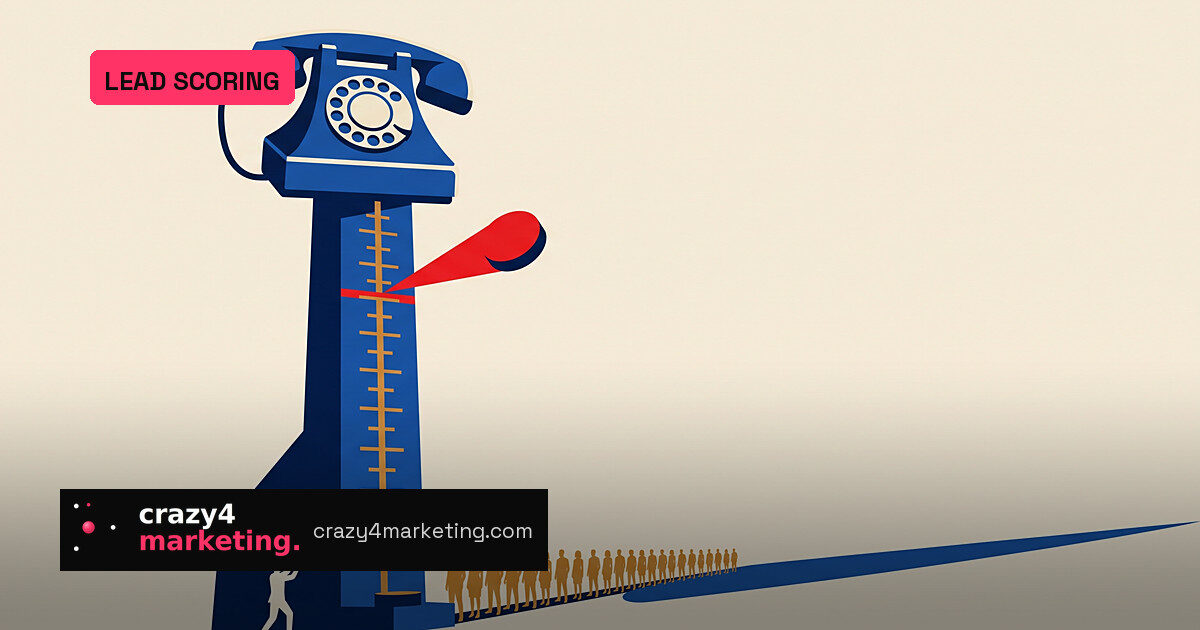
Lead scoring used to be a quiet hand-off rule: above 65 points, sales calls; below it, nurture. That threshold logic still matters, but the action has shifted. Today your score feeds ad platform bidding, and platforms are starting to compute their own.
How a score is actually built
A useful rule is to separate fit from engagement. Fit covers who the prospect is—role, seniority, company size, industry, country. Engagement covers what they did—email clicks, pricing page visits, webinar minutes, form fills. Oracle Eloqua turns fit into A-D and engagement into 1-4, creating a 16-cell grid where A1 is the hottest and D4 is quietest. HubSpot’s rebuilt tool works on a three-by-three matrix with High, Medium and Low labels.
A working B2B example shows the mechanics. A director-level title might get 20 points; a company of 200 to 1,000 employees, 15; a target industry, 15. A pricing page visit adds 10, a webinar 15, an email click 2. Free webmail might subtract 10 and an unsubscribe 20. With a threshold of 65, the right-fit director who attends one webinar qualifies; without that webinar, the same person sits at 50.
Forrester’s Laura Ramos captured the early promise: “Using numerical, quantifiable scores to grade leads turns the art of marketing into a science.” Negative signals and score decay matter too—a white paper download from last year counts less than a demo request this week.
Where scores meet ad platforms
For paid media, the question is whether a lead turned into revenue. The practical move is to send CRM lifecycle stages back as offline conversions. Google’s enhanced conversions for leads started matching hashed emails from the CRM to ad interactions in 2022. Google Ads API v24, released 22 April 2026, splits lead events into generate, qualify and close stages—so value-based bidding can chase qualified leads, not raw form fills.
Meta’s Conversion Leads goal has firm entry rules: instant forms only, at least 200 leads a month, daily CRM uploads, and a target stage reached within 28 days with a 1 to 40% conversion rate. LinkedIn’s Qualified Leads Optimization, announced in December 2024, needs five qualified leads every two weeks and claimed a 39% reduction in cost per qualified lead early on. Third parties such as Scowtt, partnering with LiveRamp in February 2026, now push predictive CRM scores to Google, Meta and TikTok around 15 minutes after a CRM event.
Google is also scoring leads itself. In May 2026 it announced Lead Intent Scores—high, medium or low—and a native leads screen with raw, qualified, converted and lost stages.
What to do now
The lesson is not to make perfect scores. It is to make them usable as feedback loops.
- Use negative points and score decay so inflated behaviour doesn’t slide into sales queues.
- Attach monetary values to lifecycle stages and send them back to the ad platforms.
- Treat engagement data as suspect: bots and fabricated submissions inflate behavioural scores, and Google’s invalid traffic filters do not stop invalid leads on their own.
Forrester’s critique is blunt: early-interest processes fail more than 99% of the time, and profile and engagement weights are often guesswork. Meanwhile, Intentsify’s QuantumDemand launch in August 2026 argued for marketing qualified accounts because buying committees grew from 6.8 to 10 stakeholders. Keep an eye on account-level scoring, but start with the plumbing: qualified conversions back into bidding.
On the compliance side, the CJEU ruled in December 2023 that credit scoring can count as automated decision-making under GDPR Article 22, and Berlin’s administrative court blocked pre-visit Schufa checks in May 2026. If a score decides whether someone gets called, lawful basis matters.
Source: PPC Land


