
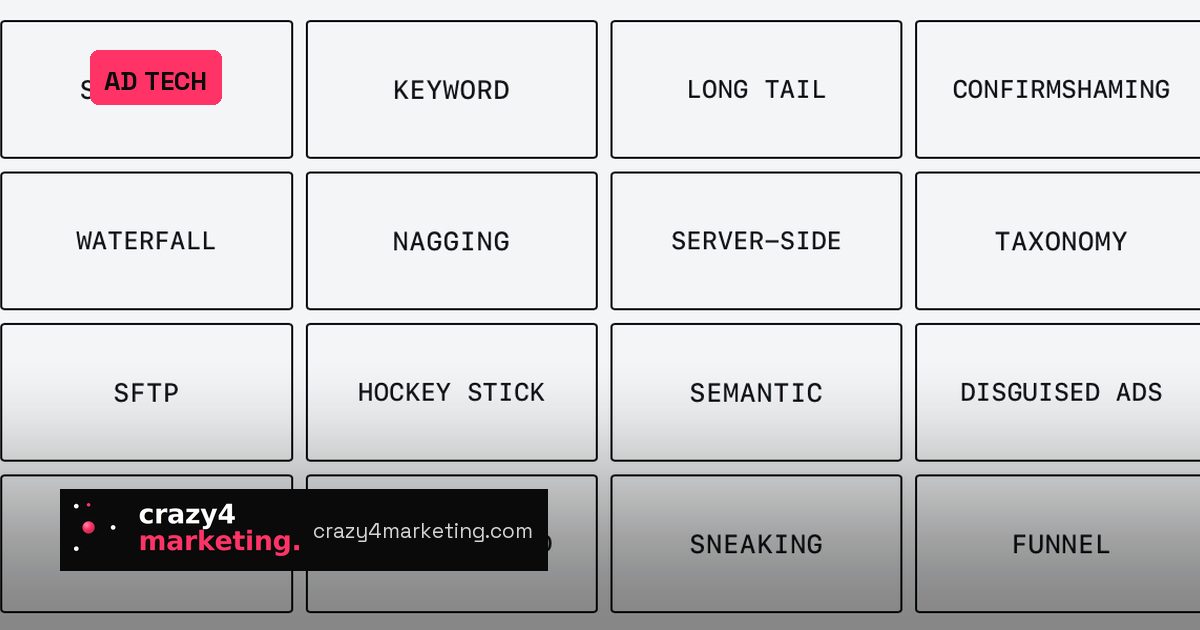
PPC Land’s latest game makes its argument right in the title: “the open web is the channel that never simplified itself.” The challenge asks readers to sort sixteen terms into four groups of four. The hard part, the publication notes, is not the heavy jargon. It is the tiles that read like ordinary English until they mean something else inside a media plan.
The framing is more than a brain teaser. It is a sharper way to describe why the open web feels so messy compared with walled gardens. Luís Rijo, who has written PPC Land daily since founding it in 2016, has published more than 10,000 reader-funded articles with no sponsored coverage. That independence gives the observation extra weight.
For digital marketers, the open web is still a maze of supply-side platforms, demand-side platforms, identity solutions, contextual signals and cookieless alternatives. Every layer brings its own vocabulary. Some terms sound like plain language, so teams assume they understand them. Then a campaign stalls and the mismatch becomes expensive.
Why the open web’s complexity is your problem
Walled gardens such as Google and Meta have spent years smoothing their dashboards, even when the underlying auction is complex. The open web has not. Budgets are shifting toward programmatic and privacy-friendly inventory, but many teams are still translating terms instead of optimizing campaigns.
That friction is a competitive tax. It slows onboarding, creates misalignment between buyers and sellers, and makes audits harder. If a term looks familiar but has a platform-specific meaning, it can hide a real strategic choice.
What marketers can do about it
The game’s lesson is practical: make the open web legible inside your own team before you add more tools.
- Build a shared glossary: Define every ad tech term your team uses, including the ones that look obvious.
- Map the stack: List each platform, what it does, and who owns it. Cut overlaps.
- Use the plain English test: If a term has two meanings, write the campaign-specific definition next to it.
- Tie tools to outcomes: Every platform should point to a metric, not just an acronym.
- Simplify before scaling: Add new channels only when the current stack is documented and understood.
A simple framework: define, map, prune, test
When a channel feels like a trivia game, use a four-step exercise. First, define the terms that are actually used in weekly decisions. Second, map them to the buyer journey or campaign workflow. Third, prune anything that does not change a decision. Fourth, test that a new hire can explain the stack in five minutes. If they cannot, the complexity is still costing you.
The open web is not going to simplify itself. But teams that treat its vocabulary as a workflow problem, rather than a badge of expertise, will move faster and waste less budget.
Source: PPC Land