

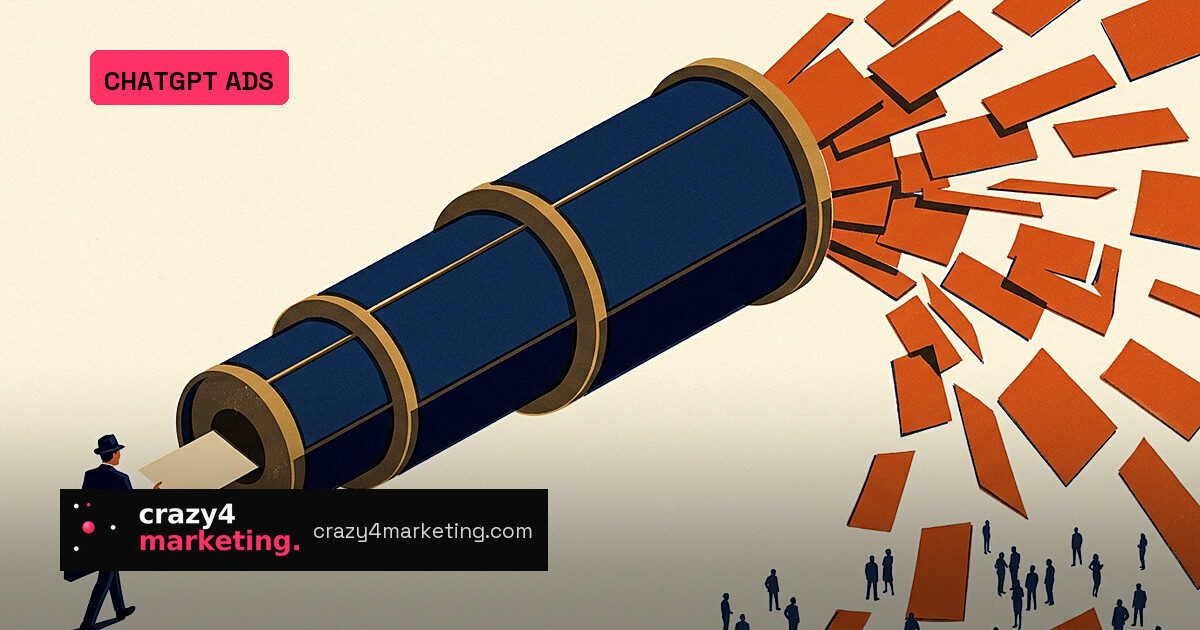
OpenAI has told advertisers it will switch on “creative enhancements” for new and existing self-serve ChatGPT campaigns by the end of October. The system will be able to rewrite headlines and descriptions, resize images, translate ad text and change destination URLs, then run those versions without the advertiser approving each one. The email, sent on October 20, gives Friday, October 30 as the start date; an OpenAI help page updated within a day now points to Thursday, October 29.
For any team that leaves the default in place, the ad a ChatGPT user sees may soon be one the brand never read. The opt-out lives in Ads Manager and must be actioned before the switch, not after.
What OpenAI is switching on
OpenAI describes the feature as making ads more relevant to the conversation and user interests while reducing the work of creating multiple versions. It draws on three inputs: your existing ad, the landing page content, and the context of the conversation. The system can then:
- create new or updated headlines and descriptions
- resize images to fit placements
- translate ad text into other languages
- optimize the destination URL to a relevant page on your site
Variations may be prepared in advance or generated in real time. The control is a single Ads Manager toggle set to “On”. OpenAI says it will preserve existing account and campaign-level opt-outs, and campaign settings take priority over account defaults. But there is no per-type control: you cannot keep manual headlines while allowing translation or image resizing.
There is also no preview of every variation, and no reporting that separates enhanced versions from the original. OpenAI’s help page cautions that changes in performance over time do not, on their own, establish the effect of the feature. That is an important admission for performance teams trying to measure what actually ran.
Why this matters now
The default-on move matters less for what it changes than for what it removes: approval, visibility and clean attribution. ChatGPT ads already report at a coarser level than they target. Adding auto-generated copy, translations and landing pages without version-level reporting makes it harder to connect a click or conversion to a specific message. For regulated categories such as financial services, a headline rewritten for relevance or translated into a language the compliance team doesn’t read carries the same legal exposure as one the advertiser wrote.
Scale raises the stakes. OpenAI says more than 100,000 advertisers have run ChatGPT campaigns since launch, with ads now sold in 89 countries. That is a meaningful base for a change that lands with nine or ten days’ notice.
The pattern is familiar. Meta’s Advantage+ creative enhancements are on by default and can generate up to 150 variations. Google has pushed AI-generated voice-overs into existing Performance Max videos and moved campaigns to AI Max with text customization switched on. But OpenAI’s switch is broader: text, translation, image sizing and landing page selection are bundled into one default toggle on a platform still labelled beta.
What to do before the deadline
First, check Ads Manager now. If you cannot accept unapproved versions, turn creative enhancements off at account level. If you’re curious, leave it on for a single test campaign and keep the rest opted out. Use campaign-level overrides to contain the test.
Second, treat any opt-in as a controlled experiment. Watch lead quality and conversion value, not just clicks or spend. Compare a non-enhanced campaign against an enhanced one, because overall trends won’t tell you whether the automation helped.
Third, revisit your final URLs and landing pages. Since the system may route clicks to pages it chooses, make sure the pages on your site that could be picked are current, compliant and on-message. The deadline is tight: the email gives Friday, October 30, but the help page now says Thursday, October 29. When sources disagree by a day, plan for the earlier date.
Paid search practitioners have already reacted sharply. Anthony Higman said he would switch ChatGPT ads off, calling the approach “pre-opted in”; Melissa Mackey said her team had paused a ChatGPT ads test over poor lead quality and was glad it did. Those are two voices, not a survey, but they land on the same point: default-on automation deserves a deliberate yes or no from the advertiser, not a silent opt-out race.
Source: PPC Land


