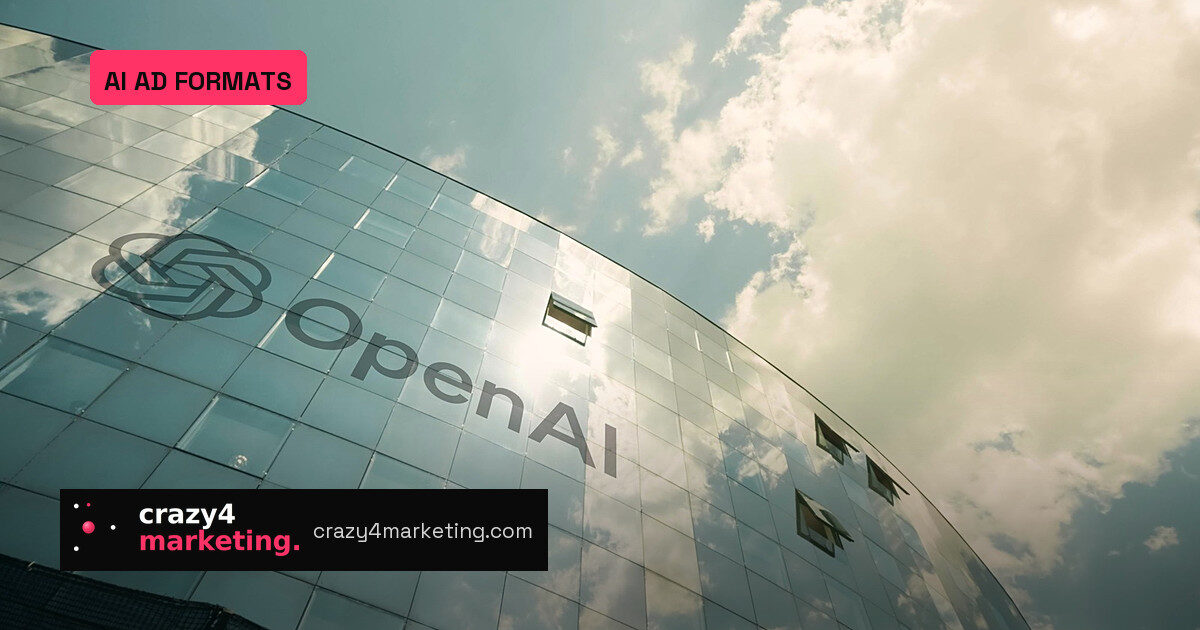
OpenAI is taking ChatGPT ads beyond the text reply. Later this month, a small group of U.S. advertisers will test a visual ad format that appears during image generation — a first for the platform. OpenAI says the placements will be clearly labeled, kept separate from the image a user creates, and won’t influence ChatGPT’s responses.
A second ad surface
Up to now, ChatGPT Ads have appeared below responses, inside the classic chat flow. The visual test changes that. ChatGPT reports 1.2 billion weekly users, but they don’t all behave the same way: some ask questions, some research purchases, some generate images, and some work with files.
Moving ads into image generation lets OpenAI monetize more of those behaviors rather than relying only on the text conversation. It also raises a design question: how much separation will actually exist between the ad and the image a user is creating? The test will answer that quickly once screenshots start circulating.
The measurement layer arrives
OpenAI is also connecting ChatGPT Ads to the tools performance teams already use. Hightouch, Tealium, and LiveRamp can send conversion data from existing systems. Attribution support now includes AppsFlyer, Triple Whale, Adjust, DV Rockerbox, and Northbeam, among others.
Incrementality is the more interesting bet. OpenAI is starting geo-based experiments with Haus, Measured, and WorkMagic to measure whether ChatGPT Ads generate additional business results — not just last-click conversions.
Some early partner results are worth noting, but not as benchmarks:
- 15.3% lower attributed CPA for WeightWatchers compared with its blended paid search benchmark, per DV Rockerbox.
- Statistically significant incremental purchase lift for Dose, reported by WorkMagic.
- 93% of Portland Leather visitors from ChatGPT Ads were new, according to Triple Whale.
The metrics measure different things, and OpenAI describes its incrementality work as early stage. Advertisers should resist the temptation to project these numbers onto their own accounts.
Brand controls are catching up
OpenAI is adding Negative Phrases for qualifying advertisers with placement restrictions tied to brand policy. Its existing guardrails aim to keep ads away from sensitive or unsuitable conversations. Brand suitability pilots with DoubleVerify and Integral Ad Science will add an independent layer of evaluation, without giving those partners access to private user conversations.
What marketers should do now
Most advertisers will not get access to the visual format yet, and OpenAI hasn’t published targeting, pricing, creative requirements, or reporting details. This is a format to watch, not a budget decision.
When access does expand, fight the urge to evaluate it on click-through rate alone. Ask three questions: Does it reach users you weren’t already capturing? Does it drive incrementality, not just attributed conversions? Can you control where your ads appear? If OpenAI can prove all three, visual ChatGPT ads earn a test. If not, it stays on the watchlist.
Source: Search Engine Journal