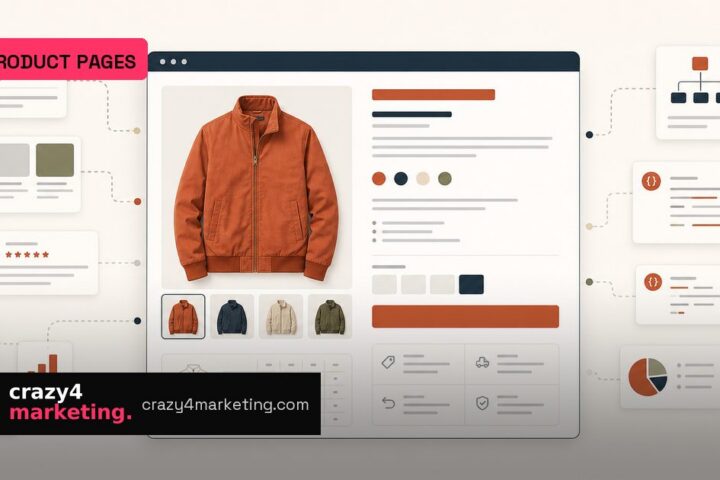

Here’s a reframe worth pinning above your desk: in digital advertising, a product is a data record. Not a thing on a shelf. A structured description of one sellable item that a merchant pushes into a platform catalogue, from which the platform builds listings, ads and, increasingly, conversational answers.
PPC Land’s explainer on the topic lays out how much weight that little record now carries. Short version: nobody writes Shopping ads any more. The machine assembles them at query time from your fields. Which makes feed quality a performance variable, not a housekeeping task.
Three words people keep confusing
Google’s product data specification separates them clearly, and most feed problems start here:
- Product — the thing a customer searches for.
- Item — that product once it exists in your product data; in a text feed, one line.
- Variant — a specific version, like one size of a shirt, bound to a parent through an item group ID and carrying its own identifier, price and approval status.
Seven attributes are required of every entry: id, title, description, link, image link, availability and price. After that it gets conditional. Manufactured goods want brand plus a GTIN or MPN; when none applies, the identifier exists attribute is the declaration you make — and setting it to false can shrink your visibility. Apparel adds colour, size, gender, age group and condition.
Why one disapproval hurts more than it used to
A disapproval is not campaign-scoped. It pulls the product from Shopping ads, free listings, conversational surfaces and image experiences all at once. Availability is checked against the landing page in both directions, and Google tightened rules in March 2026 around non-functional buy buttons — your feed declaration has to match what the page actually shows.
Approved records then do double duty. They are the unit of bidding, subdivided via listing groups and custom labels rather than keywords. And they are the unit of reporting: from 15 June 2026 Google extended product-level cost and conversion metrics beyond Shopping and Performance Max into Video, Demand Gen and App campaigns. Merchant Center followed on 24 August 2026, splitting YouTube affiliate traffic out of the organic bucket and widening paid figures — with a warning about a one-time jump in impressions and clicks. If your August dashboards looked weird, that’s why.
The plumbing changed too
The Content API for Shopping shut down on 18 August 2026, a date locked in when the Merchant API hit general availability in August 2025. Under the Merchant API a product resource is named accounts/{account}/products/{product}, with a composite key in the form contentLanguage~feedLabel~offerId — the documented example being en~US~sku123. Identifiers containing a slash, percent sign or tilde must be submitted as unpadded base64url, and Google recommends that encoding for all of them. Prices go in micros: 15,990,000 micros equals 15.99 dollars.
The AI-surface squeeze
Above your account sits the Shopping Graph, which Google said at Google Marketing Live in May 2026 holds more than 60 billion listings with over 2 billion updated hourly. Free listings, Shopping ads, AI Mode, Gemini and Lens all pull from it.
But visibility there is contested. Productrise research reported in late July 2026 found AI Mode returning roughly 95% fewer Shopping listings than standard search for identical queries, with only 0.8% product overlap between the two on the same day. A later dataset of more than 2 million listings found the same products showing 21.6% higher prices in AI Mode. Google has not published counter-measurement.
Meanwhile the attribute list keeps growing. Google announced dozens of conversational attributes in January 2026; practitioners identified eight tied explicitly to AI experiences, including product highlight, product detail, variant option and related product. FeedArmy founder Emmanuel Flossie reported one client seeing an 80% improvement in Google ads performance from product data changes alone — no bid or creative edits. Treat that as a single practitioner case, not a benchmark.
Dates to put in your calendar
The 2026 specification, published 14 April, raised minimum image resolution to 500×500 pixels and added handling cutoff time, minimum order value, video link and loyalty shipping sub-attributes. Warnings started that day; enforcement begins 31 January 2027. Pickup cost and minimum order value become mandatory for in-store products in the UK, Switzerland and the EEA on 30 September 2026.
One caveat on automation: Merchant Center automatic import claims a 24-hour refresh, but testing on 13 January 2026 found data nine days stale. The AI import beta added in May 2026 does a one-time site scan with no refresh promise and assigns identifiers algorithmically — which breaks the link between feed IDs and your own remarketing tags. Use with care.
Audit your seven required fields, fix images before January 2027, add the conversational attributes, and stop treating the feed as an IT job. It is the interface.
Source: PPC Land