

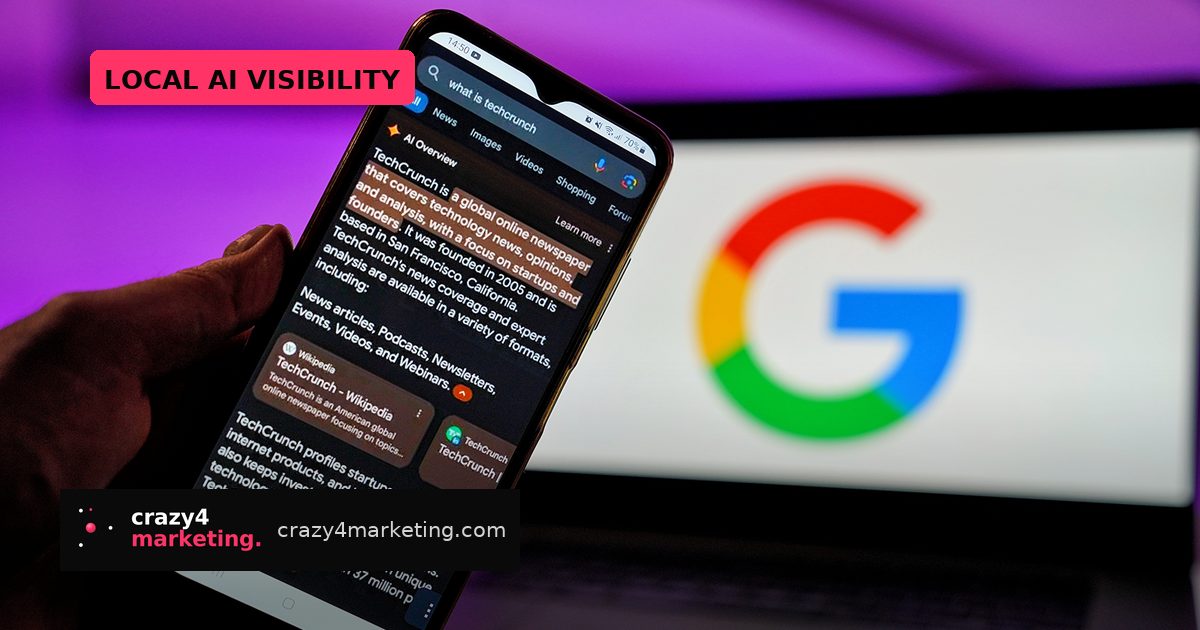
Ask ChatGPT for the best plumber in your city. Two or three names come back. That shortlist is the new page one — and there is no page two.
A sponsored piece from Reviewly.ai on Search Engine Journal lays out how local businesses can engineer their way into those answers. The tactics are old-school local SEO fundamentals, but the stakes have changed completely.
The numbers behind the shift
Google’s AI Overviews now reach more than 2.5 billion users a month and show up on roughly half of tracked searches, per the article. ChatGPT crossed 1 billion weekly active users in 2026, up from around 400 million about 18 months earlier — and a big chunk of those chats are “who should I hire” questions.
Here’s the twist that matters for local operators: AI Overviews still trigger on only single-digit percentages of clearly local queries, versus that ~48% average across all query types. For “emergency electrician open now,” Google still leans on the map pack.
Translation: the local AI format is immature. That’s the arbitrage window. Build the signals now and you become the default answer before the format catches up.
Getting found vs. getting chosen
The piece splits AI visibility into two jobs. Getting found means the model knows you exist, what you do and where. Getting chosen means it actually names you.
Classic SEO only ever solved the first. AI collapses both into one moment — the model hands over a pre-vetted shortlist instead of ten links. Miss the shortlist and you’re not in the consideration set at all.
The five signals models cross-check
According to the article, AI platforms synthesize your business from Google, Yelp, Reddit, Facebook and your own site, then look for agreement across them. Five signals do the work:
- Reviews — volume, recency, sentiment and the actual language in the review text. The heaviest signal for local intent.
- Google Business Profile completeness — categories, hours, service areas, attributes, Q&A. Gaps are a reason to leave you out.
- NAP consistency — when directories disagree on your name, address or phone, model confidence drops and a verifiable competitor wins.
- Your website as corroboration — does your site back up what reviews and your GBP claim? Vague homepages hurt.
- Third-party mentions — Reddit threads, local news, directories, social profiles. Independent confirmation equals safety.
The through-line: AI recommends what it can verify from multiple independent sources. No single hack wins.
Why reviews carry the most weight
A 2026 consumer survey cited in the piece found nearly all consumers read reviews for local businesses, with the share who always read them before choosing jumping to roughly four in ten in a single year. Ranking-factor studies attribute close to a fifth of local pack influence to review signals. And about three in four consumers weight recent reviews more heavily than old ones.
Models mirror that behaviour. A stale wall of two-year-old reviews reads like a business that may have closed. Fresh, detailed reviews read as active and safe to recommend.
Two fixes most teams miss. First, AI reads the review text, not just the stars. “Great service” is useless. A review describing a water heater replaced in under three hours, cleanup included, is dense with the service and outcome language that matches real queries. Change the ask: “tell us about your experience” beats “leave us a review.”
Second, owner responses count. Replying — especially to negatives — signals accountability and gives you a natural place to add service keywords and location context. Across hundreds of reviews, that compounds.
The 90-day plan
Days 1–7: Audit yourself. Ask ChatGPT and Perplexity to recommend businesses in your category and city. Search your own brand name. Screenshot everything — that’s your baseline. Fix GBP categories, hours and service areas.
Days 8–30: Trigger SMS review requests on job completion (they convert far better than email because the experience is still fresh). Fix your top ten NAP inconsistencies. Publish service-area pages for your three highest-revenue services.
Days 31–60: Add LocalBusiness schema, validate with Google’s Rich Results Test, build a real FAQ page using questions customers actually ask. Q&A pairs are the format models love to quote.
Days 61–90: Re-run the audit. Compare against your Day 1 screenshots. Tune review request timing based on what converts.
The strategic point for growth teams: visibility here is a recurring process, not a launch. Steady weekly signals beat occasional spikes. And the gap between businesses that get named and those that stay invisible is widening every quarter.
Source: Search Engine Journal