
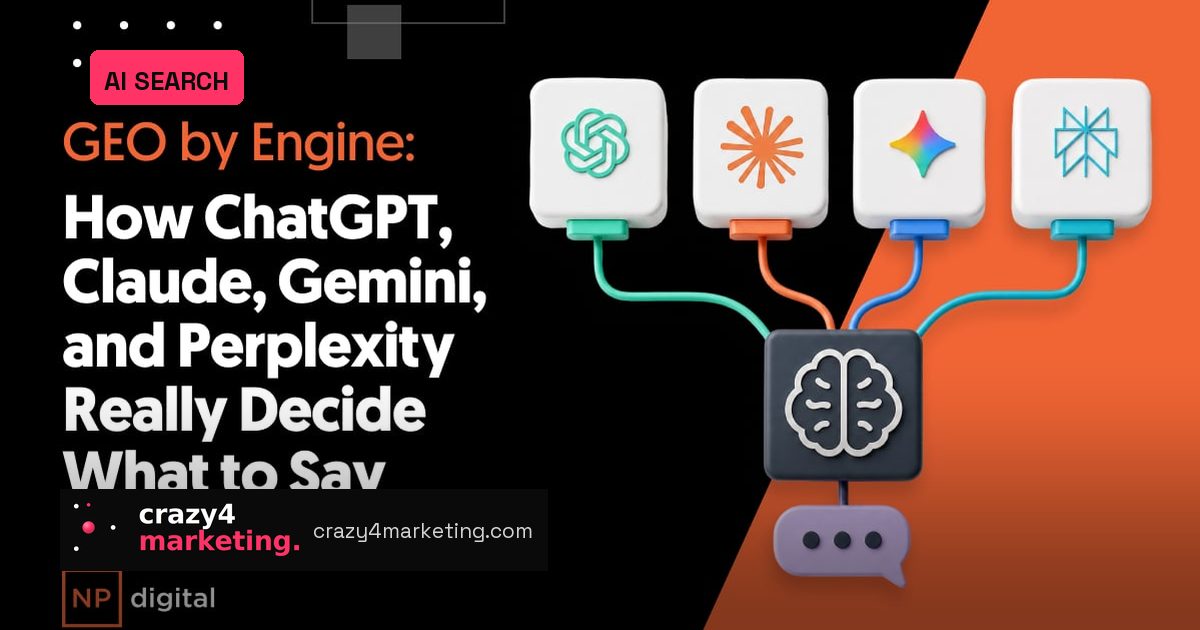
Most GEO advice treats “optimize for AI search” as one playbook. The moment you test that against ChatGPT, Claude, Gemini and Perplexity, the cracks show. They share a training foundation, but each engine is tuned to reward different signals, retrieve different sources and answer in different shapes.
The shared recipe, tuned four ways
All four engines run a similar pipeline: pretraining on large text sets, instruction tuning, preference optimization and product-level retrieval decisions. Preference optimization is where default behavior gets shaped. Early public datasets such as Anthropic’s 2022 hh-rlhf used simple binary human judgments. By 2024, Nvidia’s HelpSteer2 graded responses across five axes: helpfulness, correctness, coherence, complexity and verbosity.
An independent analysis of those public datasets found that the newer five-axis rubric appeared to favor more structured, list-shaped answers in a majority of sampled pairs. Treat that as an informed signal, not a live spec. The files are historical snapshots, not current ranking formulas.
Where the engines actually diverge
Perplexity is built for retrieval. It leans on live web pulls and citations, so source-rich, factual content tends to travel better than persuasive copy. Claude is tuned for depth and long-form reasoning, which makes it stronger for calibrated, multi-step work. ChatGPT carries the broadest feature set and user base, so content that works as both a full explainer and a set of shorter conversational pieces tends to perform well. Gemini’s edge shows up inside Google’s ecosystem: Gmail, Docs, Sheets, YouTube and Workspace data the others cannot see.
A single generic GEO checklist underperforms against these differences. Platform-specific tactics follow from the mechanics:
- Perplexity: prioritize original research, cited stats and clean, self-contained statements that can be lifted into an answer.
- Claude: lead with structure, depth and a clear point of view from real experience, not surface-level listicles.
- ChatGPT: make content modular enough to serve full explainers and follow-up questions across multiple surfaces.
- Gemini: invest in entities, schema markup and structured data so Google’s systems can parse your content alongside your brand data.
Engines also differ on source weighting. Some favor a brand’s own domain. Others lean on third-party citations. Several reward structured, schema-marked data over plain prose regardless of publisher. That changes where you spend effort: publishing more on your own site, earning citations, or making existing content more machine-readable.
Rethink your AI visibility metrics
Keyword rank alone won’t tell you if AI engines are using your content. Watch citation frequency, brand mentions, direct answer placement versus secondary links, source diversity at query level, query match quality and content freshness. For retrieval-heavy engines like Perplexity, recency can be a meaningful signal.
Start with one platform where your buyers already ask questions. Apply the engine-specific lever, measure citation and mention shifts, then expand.
Source: Neil Patel