

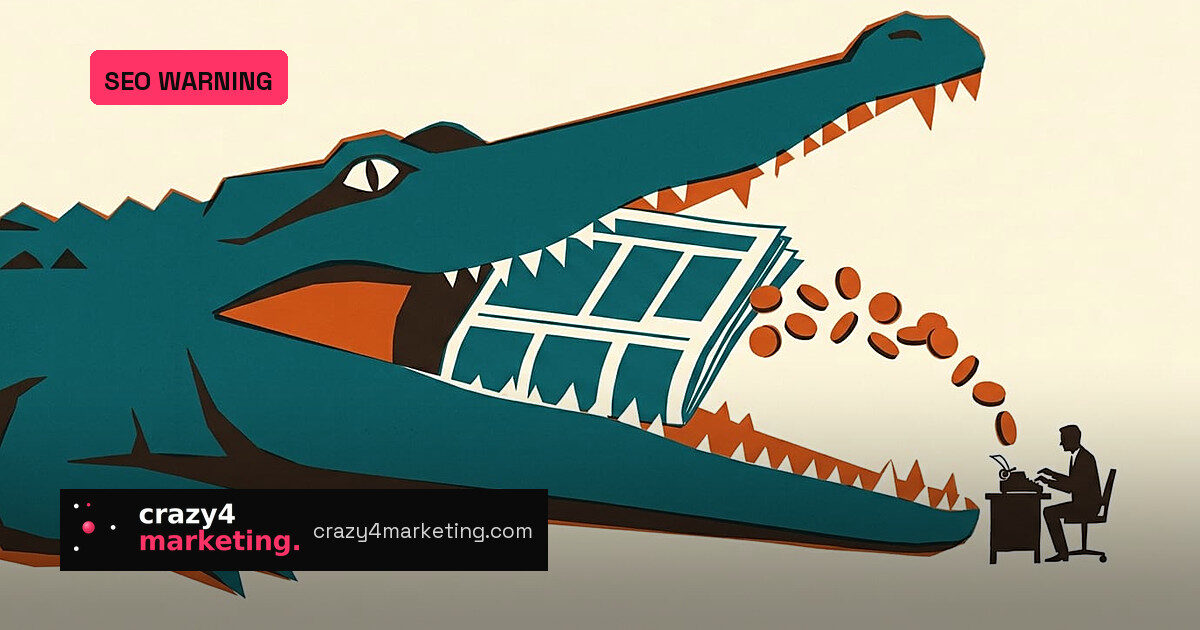
A new Check My Ads Institute report makes a blunt claim: Google gets paid twice from the same publisher content. First, the report argues, Google uses publisher material to power its AI features. Then it sells ads inside AI Overviews, where the publisher’s link and ad slot used to be. The result is a two-sided squeeze on newsrooms.
The Crocodile Effect
The report borrows a term credited to marketing expert Tim Soulo: The Crocodile Effect. The image is simple. Search impressions are rising while clicks fall, like an opening jaw. Pew Research Center data illustrates the gap: in March 2025, when an AI summary appeared, users clicked a traditional result on 8% of visits. Without one, the rate was 15%. Links inside the AI Overview itself were clicked only 1% of the time.
A top-ranked page can feel it too. The report, citing Authoritas coverage via The Guardian, says a site that used to rank first for a query could lose about 79% of traffic for that query when results sit below an AI Overview. It also cites Digiday that some publishers have reported up to 90% website traffic declines over the past year, an upper bound, not an industry average.
The report’s sharpest line: “Publishers aren’t necessarily losing their audiences, but rather their ability to reach them. Google is effectively eating its own supply chain.”
Where the click disappears
The economics matter because programmatic revenue starts with a click. No click, no publisher pageview, no ad slot. The report argues Google substituted ads on its own real estate in AI Overviews, without the revenue share that would have gone to the original publisher.
There is a measurement problem too. Check My Ads says Search Console doesn’t separate general search from AI Overviews and AI Mode. Google did launch a generative AI report on June 3, 2026, and an opt-out for AI features that reached all sites on August 31, 2026. But that report shows AI impressions, not clicks or queries. The core complaint, that publishers cannot see click-level AI impact, remains.
The second squeeze: made-for-advertising sites
The report’s other target is MFA inventory. These pages, often AI-generated and bot-heavy, siphon advertiser budgets that might otherwise reach real publishers. The report cites older but striking figures: 21% of impressions and 15% of ad spend went to MFA placements in 2023, and 15% of programmatic revenue is an unknown delta that never reaches publishers.
For digital marketers, the practical checklist is clear:
- Check Search Console’s generative AI report to see where your pages appear in AI features.
- Treat the AI Overviews opt-out as a controlled test, not an automatic switch.
- Ask programmatic partners for log-level data and MFA exclusion guarantees.
- Use the 90% traffic-loss figure as an upper bound for scenario planning, not a forecast.
Google’s opt-out does not cover AI training, which sits under a separate Google-Extended control, and it does not remove the tension between being indexed and being summarised. Marketers should watch both the search result page and their ad supply path.
Source: PPC Land


