
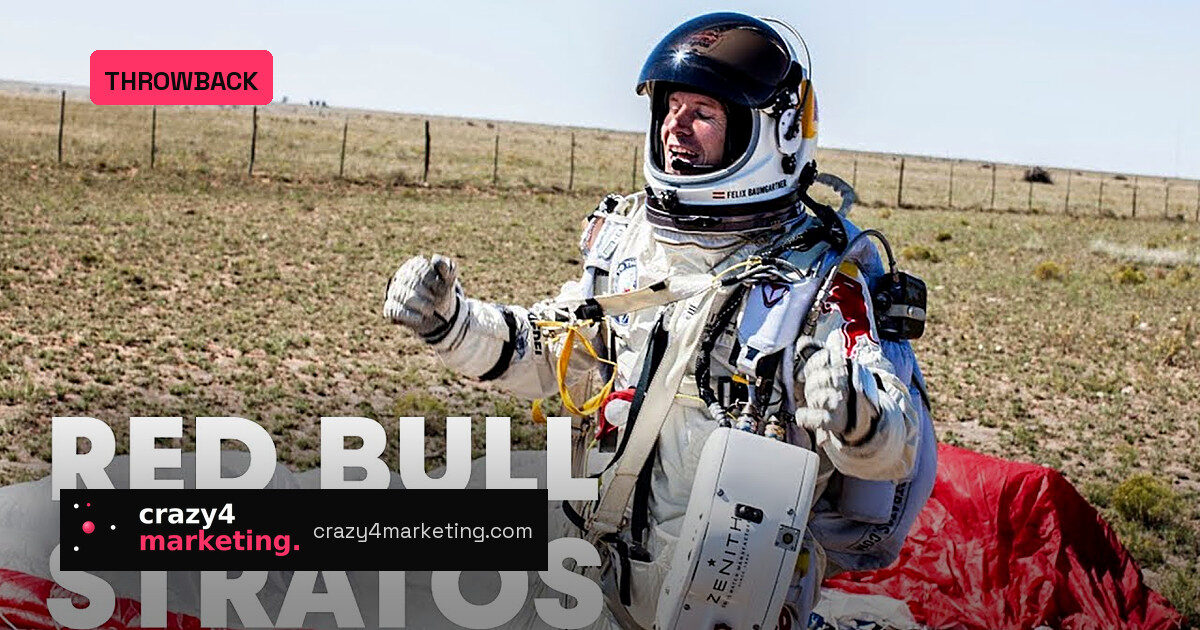
Before Red Bull Stratos, branded content mostly meant a logo tacked onto an extreme sports clip. After 14 October 2012, it meant live-streaming a man jumping from 128,100 feet and letting the world watch him fall faster than sound.
The hook and when it ran
Red Bull Stratos went live on 14 October 2012 after weather delays. The hook was brutally simple: Felix Baumgartner would ride a pressurized capsule beneath a helium balloon to the edge of space, then step off. The film above is the full arc of that attempt, not a cutdown or a highlight reel. Red Bull didn’t rent attention. It built a mission and pointed cameras at it.
How the film was built
The campaign wasn’t conceived as a 30-second spot. Red Bull treated the entire operation as the creative work. That meant a pressurized capsule, a custom suit, a mission control team and a live data layer tracking altitude and speed. The broadcast is the ad. The brand appears as infrastructure—on the suit, on the capsule, in the telemetry—rather than as a sales message. There is no product shot. The operational risk is the product, and it is far more persuasive than a scripted tagline.
Why it spread in its day
In 2012, live video still felt like an event, and this one had real stakes. Baumgartner became the first person to break the sound barrier in solo freefall, but the outcome was never guaranteed. Viewers could watch the ascent, the system checks, the countdown and the jump itself. The live feed drew roughly eight million concurrent viewers, a record at the time. Then the moment fragmented: newsrooms cut their own versions, screenshots traveled, and clips circulated without Red Bull pushing them. It spread because it was live, uncertain and easy to share.
What it did for the brand
Red Bull had already spent decades aligning itself with extreme feats. Stratos moved the brand from sponsor to broadcaster. It proved Red Bull could run a global media event and hold an audience without renting one. The footage became a long-tail asset—documentaries, athlete profiles, record coverage. After the jump, Red Bull was understood less as a drinks company that made ads and more as a media company that happened to sell an energy drink.
Steal this
Three moves from Stratos still work:
- Design for live tension, not a scripted reveal. A countdown, a clear record and a real chance of failure hold attention longer than a polished punchline.
- Make the brand the infrastructure, not the interruption. Put the logo where the action is—on the equipment, the data, the control room—and skip the product speech.
- Let the audience own the moment. Clean, shareable visuals turn viewers into distributors and invite newsrooms to amplify you.
Watch the original: Red Bull on YouTube