

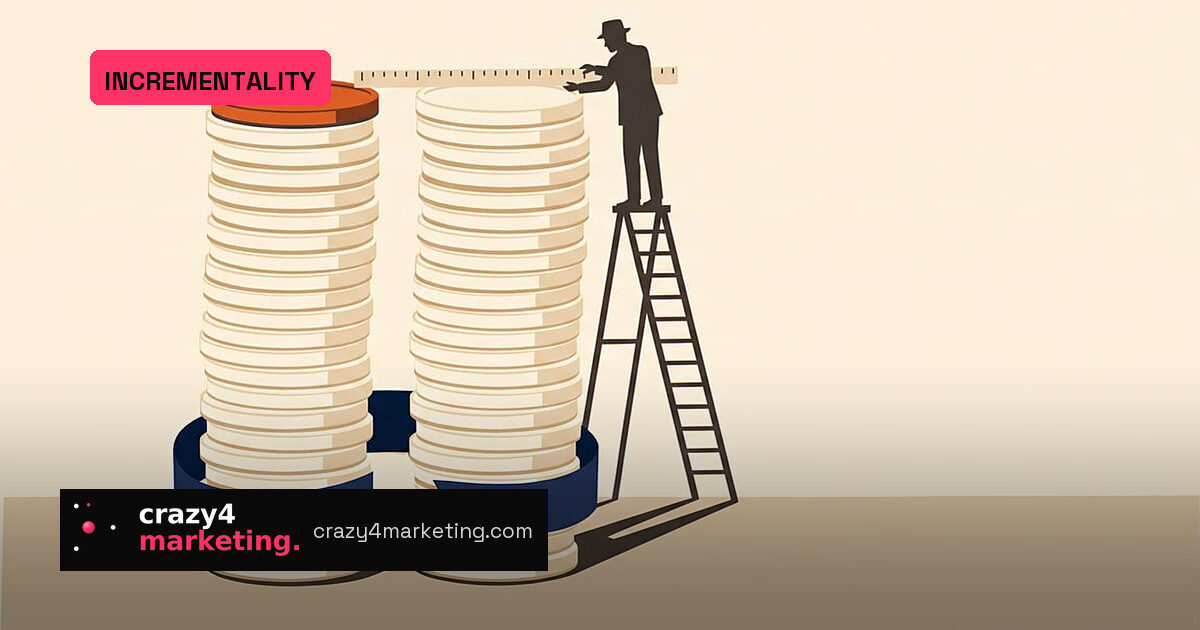
Most dashboards show one number: ROAS. Incremental ROAS (iROAS) asks the harder question — which sales would have happened anyway? It is not a tweak; it changes budget decisions.
The math that changes the story
ROAS counts every sale your attribution rule credits to an ad, including purchases that were already coming. iROAS replaces that numerator with the difference between what happened with ads and what would have happened without them. That counterfactual cannot be observed, so it has to be estimated by holding back a control group.
Take a retailer that spends 20,000 euros and sees 120,000 euros of attributed sales. That is a 6.0 ROAS. In a holdout test, the exposed group generated 260,000 euros and a comparable unexposed group generated 230,000 euros. The incremental lift is 30,000 euros. Divide by the 20,000 euros of spend and iROAS is 1.5.
Revenue is not profit either. At a 40% gross margin, 30,000 euros of incremental sales yields only 12,000 euros of gross profit. The break-even iROAS is 2.5, so a reported 6.0 ROAS can still lose money on the first purchase.
How the counterfactual is built
PPC Land groups the methods into three families:
- User-level holdouts: Randomly split an audience and suppress ads for the control group. Google’s Conversion Lift and Meta’s Conversion Lift work this way, and Google cut the minimum budget to $5,000 in November 2025.
- Geographic experiments: Change spend in some regions, keep others unchanged, and use pre-test data to predict the control. No user identifiers needed, but few regions make it hard.
- Marketing mix models: Estimate incremental return from years of weekly sales and spend. Google’s Meridian and Meta’s Robyn cover every channel at once but rely on assumptions rather than randomisation.
Why it matters for budget calls
Attributed ROAS is the number used to justify budgets, and platforms grade their own homework. iROAS gives finance teams a number closer to the economic question. Meta has gone further: since June 2025, incremental attribution optimises delivery toward conversions predicted to be incremental.
The gap can run both ways. Meta’s research says rules-based attribution undervalues Meta by 31% at the median. A vendor study says siloed retailer attribution misses 36% to 53% of retail media impact. Both findings come from parties that benefit from larger measured returns.
Read the fine print before you trust a number
Statistical power is the first limit: many campaigns cannot be measured precisely at affordable sample sizes, and an interval that includes zero is not proof of failure. Who runs the test is the second. Measurement product lead Karan Dhir argues standard methods miss experimental ground truth ‘frequently by a factor of 3 or more’. Definitions also vary: average versus marginal iROAS, total versus incremental spend, and short windows that can understate lift by up to 17% for long conversion lags.
Before you scale spend, ask for the control group, the denominator, the confidence interval and the test length. Then decide whether your 6.0 is really a 6.0.
Source: PPC Land


