

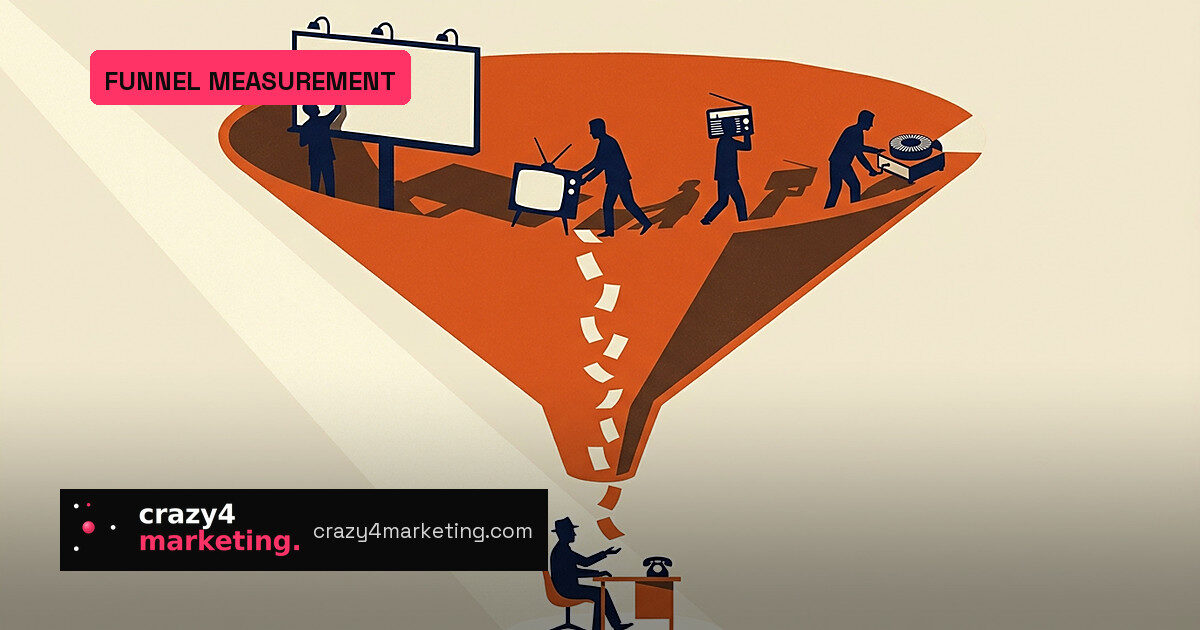
Full-funnel measurement is not a single dashboard. It is a stack of methods that answer different questions – and a discipline that stops the last click from deciding your budget.
Why last-click keeps getting it wrong
Last-click attribution credits the final interaction before a sale. That makes branded search and retargeting look wildly efficient while video, audio and display – the channels that create demand weeks earlier – appear nearly worthless.
The gap is measurable. Meta’s white paper “Building a Suite of Truth,” published May 28, 2025, drew on 307 studies run by 54 advertisers between March 2022 and November 2024. It found rules-based attribution undervalued Meta ads by 31% at the median. Fospha, a measurement vendor, defines the fix as tracking “a customer’s complete path across every stage of the funnel.”
Build the stack, not a dashboard
No single tool covers the whole funnel. The practical setup combines four layers:
- Stage metrics: reach, frequency and ad recall at the top; site visits, branded search and add-to-carts in the middle; conversions, CPA and ROAS at the bottom.
- Attribution: multi-touch and data-driven models for fast, granular steering – they show correlation, not cause.
- Experiments: brand lift, conversion lift and geo tests that compare exposed and control groups to estimate incrementality.
- Marketing mix modelling: a two-to-three-year view that captures adstock, seasonality and pricing effects.
The final step is calibration. Google’s November 2022 guidance warns that attribution should not be treated “as a stand-alone measurement solution.” Use experiment results to correct attribution multipliers and set priors in the mix model, so the methods converge.
Platforms are building the rails
In 2026 the platforms moved beyond last-click. TikTok launched its Attribution Portfolio on May 13, with assisted-conversion reporting it says captures 80% of conversions within nine days of exposure. At Google Marketing Live on May 20, Google placed Meridian inside Analytics 360 and introduced Qualified Future Conversions, counting purchases up to 180 days after a click when a qualifying action happens within seven. Amazon DSP opened self-serve access to more than 50 third-party measurement studies.
Why budgets follow the clicks
A simple example makes the stakes clear. A retailer spends $100,000 each on YouTube and branded search. Last-click reports 4,000 orders for search and 200 for YouTube. When a geo experiment switches off YouTube, branded search orders fall 20% in those regions – proof that search was harvesting demand video created.
The pattern repeats across channels. Audio takes 31% of consumer media time but only 9% of budgets, partly because there is, as ExchangeWire COO Lindsay Rowntree puts it, “very little last-click attribution abilities with audio.” Adoption is still thin: an Incubeta survey from May 2026 found just 34.4% of retail leaders use a unified short- and long-term measurement approach.
Treat vendor proof as a starting point
Not every big number deserves equal trust. The IAB’s November 2025 guidelines place platform-reported incrementality in the weakest evidence tier. When the same company sells the media, runs the model and sets the bids, circularity is a live concern. Run your own geo or conversion lift tests before reallocating budget.
Full-funnel measurement is not about trusting one model. It is about making three imperfect methods disagree less – and finally giving demand creation the credit clicks never could.
Source: PPC Land


